Organized by the Canadian Association of Food Studies (CAFS) ad hoc Committee on Palestine and the Right to Food
In this discussion, panelists examine the relationship between food, empire and colonialism, drawing connections between the current genocide in Gaza with colonial projects across Africa and Turtle Island. Panelists discuss how imperial and colonial regimes have and continue to use deliberate starvation and the weaponization of food and food growing lands as a means of genocidal violence.
Amid the horrific settler colonial violence happening in Gaza, we also raise crucial questions about the role of food in culture, identity and connection to land. We ask: What pathways exist across colonial contexts to revive, repair and sustain seed and food sovereignty for colonized peoples fighting for freedom, life, and liberation?
Panelists:
Justin Podur runs the Anti-Empire Project podcast and youtube channel including the Gaza War Sit Rep series and the Civilizations historical series. He is the author of Siegebreakers, a 2019 speculative novel where Palestinians win a war of liberation. He has been to Gaza and the West Bank and was a volunteer with the International Solidarity Movement (ISM) in 2002.
Yafa El Masri is both a refugee and a researcher. She has a PhD in Human Geography and an MSc in Local Development Studies from the University of Padova, Italy. She is currently a Postdoctoral Research Associate at the Department of Geography at Durham University in the UK. She is also the leader of the Decolonizing Development Research Work Group, at the EU-funded Decolonizing Development COST Action (DecolDev). She has various Academic and non-academic publications in books, journals, and digital platforms. As a Palestinian refugee herself, Yafa’s main research focus is Palestinian refugees and their waiting zones, but her broader set of research activities are centered around refugee studies, decoloniality, and critical development studies. Yafa has years of experience working in grassroots community-based organizations in addition to International Organizations such as the UNRWA.
Max Ajl is a Senior Fellow at University of Ghent and an associated researcher at the Tunisian Observatory for Food Sovereignty and the Environment. He is an associate editor at Agrarian Southand Journal of Labor and Society, and has written for The Journal of Peasant Studiesand the Review of African Political Economy. His book, A People’s Green New Deal, was published in 2021 with Pluto Press.
Hosted Thursday May 9th 1-3pm EDT, ZOOM. Watch the recording of the panel above
Are you interested in pursuing a graduate degree? Do you have a passion for agriculture, food systems, geography and rural studies, and/or science and technology studies? If so, please read this recruitment flyer and feel free to reach out with any questions!
The Research: We are seeking highly motivated graduate students who want to complete a Master’s or PhD and are interested in conducting social science research related to issues of digitalization, financialization, and consolidation in the agrifood sector in Saskatchewan and Ontario.
The research will contribute to a multi-year SSHRC project, led by André Magnan (University of Regina), Sarah Rotz (York University), and Annette Aurélie Desmarais (University of Manitoba), examining three intersecting processes:
1. Digitalization: the growing importance of digital technologies such as satellite and drone imaging, GPS-guided machinery, robotics and Big Data in agriculture
2. Financialization: the increasing influence of financial actors and logics in the agricultural sector
3. Consolidation: the increasing concentration of farmland and other agricultural resources into fewer hands.
Students involved in the project will benefit from working collaboratively with the research team and are invited to pursue their own research interests and develop a project that fits within the overarching project themes.
The Funding: The successful applicants will receive a stipend of $17,500/year (MA) or $20,000/year (PhD) plus research expenses to conduct fieldwork in Saskatchewan or Ontario. Students will be encouraged to pursue additional sources of funding, including scholarships and TAships.
The Opportunities: The research will form the basis of the student’s thesis or dissertation. As key members of the project team, graduate students will have opportunities to collaborate with other researchers, present their work in seminars/workshops, and publish in newspapers/magazines and peer-reviewed journals. Students will be trained in project management, social science research methods, and knowledge mobilization.
How to apply: We are accepting students at programs at either University of Regina or York University. Applicants should email their queries, including a CV, and a letter of interest explaining their interest in digital technologies, rural development, and/or farming to the researchers listed below. Please note that we will consider start dates of Fall 2024 or 2025. Students currently enrolled in a Master’s or PhD program are invited to apply.
Applicants wishing to study at York University will be supervised by Dr. Sarah Rotz (Assistant Professor, Faculty of Environmental and Urban Change). Depending on the interests of the student, it may be possible to complete a Master’s in Environmental Studies, Geography, or Science and Technology Studies. Please contact her at rotzs@yorku.ca
Applicants interested in studying at the University of Regina will be supervised by Dr. André Magnan (Professor, Department of Sociology and Social Studies). Students may complete their MA in either Sociology or Social Studies, depending on their interests and background. The Social Studies program is appropriate for students with a social science or interdisciplinary background and provides a strong grounding in methodology and theory. Please contact him at andre.magnan@uregina.ca
Deadline:
Applicants to York University must apply by February 15, 2024 if looking to apply directly to the program (program details and deadlines can be found on the program webpages). Later applications will be considered if the positions remain unfilled.
Applicants to University of Regina are strongly encouraged to submit their application by March 15th, 2024. Later applications may be considered if the positions remain unfilled.
RAIR has been in dialogue with many amazing folks to explore Indigenous land rematriation and land sharing within the context of ongoing settler colonialism here in so-called Canada. Through these dialogues we’ve been learning about Indigenous laws, languages, governance systems, relationships to land, food sovereignty practices and how land relations are being (re)imagined.
We hope that this podcast series can help to deepen understanding around and build support for Indigenous-led land, food, and climate action.
Happy 2021 fall semester! We’re happy to invite you to the YUFA Climate Emergency Committee’s (YCEC) next Climate Talk entitledTackling climate change via changes in energy use: Insights from research on human needs, need satisfiers and participatory workshops with Dr. Lina Brand Correa on Friday September 17 at 1PM
About the Climate Talks series: The Climate Talks series highlights the scholarship, research and activism of scholars and climate organizers across York University and beyond. The aims of this series are to advance the discussion on climate issues and to build a strong community of people in order to collectively strategize for climate action at York University and through YCEC. YCEC was created by the York University Faculty Association to address climate issues and advance climate actions and activities at York University. Working with staff and students, YCEC is building a strong coalition of researchers and activists concerned with the climate emergency.
Upcoming YCEC Meetings and Talks: October 8th: YCEC Climate Meeting – Please join us to learn more about YCEC and how to get involved! November 26th: Climate Change and Growing the Planthroposcene with Dr. Natasha Myers
As a co-chair of the YUFA Climate Emergency Committee (YCEC) with Dr. Sheila Colla, we are organizing the Inaugural Climate Talks series:
This series will highlight the scholarship, research and activism of scholars and climate organizers across York University and beyond. The aims of this series are to advance the discussion on climate issues and to build a strong community of people in order to collectively strategize for climate action at York University and through YCEC. YCEC was created by the York University Faculty Association to address climate issues and advance climate actions and activities at York University. Working with staff and students, YCEC is building a strong coalition of researchers and activists concerned with the climate emergency. To be added to the YCEC listserv or to learn more, contact us at: yufaclimateemergency@gmail.com
Save the date for upcoming talks in the series:
July 16, 2021, Indigenous Energy Sovereignty and the Politics of Climate Change with Brock Pitawanakwat & Candis Callison Brock Pitawanakwat, an Anishinaabe from Whitefish River First Nation, is Associate Professor and program coordinator of Indigenous Studies in York University’s Department of Humanities. He is a research fellow with the Yellowhead Institute and a regular panellist with Media Indigena’s weekly round table. Candis Callison is a Canadian environmental journalist and academic of journalism, who works as an Associate Professor at the University of British Columbia, affiliated both with the School of Journalism, Writing, and Media and the Institute for Critical Indigenous Studies at UBC.
August 13, 2021, On thin ice: Are lakes feeling the heat? with Dr. Sapna Sharma
Dr. Sharma is an Associate Professor in the Department of Biology at York University and a York Research Chair in Global Change Biology. She is head of the Sharma Laboratory which is currently researching the impacts of multiple stressors on lake ice phenology, water temperatures, water quality, primary production and fish communities.
Friday April 30th at 1:00PM Political Economies of Climate Change and Indigenous Rights in the North with Gabrielle A Slowey
Gabrielle Slowey is an Associate Professor in the Department of Politics at York University and is a member of the graduate programs in Politics and Socio-Legal Studies. She is also the Director of the Robarts Centre for Canadian Studies at York. She was the inaugural Fulbright Chair in Arctic Studies at Dartmouth College (USA) and a York-Massey Fellow. Her research focuses on the political economy of land claims, treaties and self-government, especially across the north/Arctic and in areas where resource extraction takes place. Her work considers questions of community health, environmental security, climate change and Indigenous rights in these contexts. Her approach is very much community-based and community-driven research. It draws upon broader theoretical concerns of colonialism, reconciliation, staples and democracy.
May 28, 2021, Cinema, Media, & Climate Change with Janine Marchessault & Melanie Wilmink and their exhibition titled Life, A sensorium.
Janine Marchessault is a professor in Cinema and Media Arts and holds a York Research Chair in Media Art and Social Engagement. Her research has engaged with four areas: the history of large screen media (from multiscreen to Imax to media as architecture and VR); diverse models of public art, festivals, and site specific curation; 21st century moving-image archives and notions of collective memory/history. She is a founder of the Future Cinema Lab, and the 2014-2016 inaugural Director of Sensorium: Centre for Digital Arts Research. A Trudeau Fellow, she is also a Fellow of the Royal Society of Canada. She belongs to the CinemaExpo67.ca research group and is a founding member of the Public Access Curatorial Collective. Her latest project is an expanded cinema festival Outer Worlds outerworlds.org—commissioning five IMAX films by artists which premiered at the Cinesphere in 2019 as part of Images Festival. She is also the PI of Archive/Counter-Archive: Activating Canada’s Audio-Visual Heritage (2018-2025) counterarchive.caMelanie Wilmink holds a PhD in Art History at York University. Her research examines the relationship between spectatorial experience and exhibition spaces within interdisciplinary media installations. This academic research is supported by her curatorial work including various projects as Programming Coordinator at the Calgary Society of Independent Filmmakers (2007-2012), the Situated Cinema Project mobile micro-cinema (Pleasure Dome, 2015), and the Winter Warmer (Sidewalk Labs Toronto, 2019). Her recent publications include the anthology Sculpting Cinema (2018) and Landscapes of moving image: prairie artists’ cinema(forthcoming), both co-edited with Solomon Nagler. www.melaniewilmink.com.
June 18, 2021, Climate Change, Energy & Indigenous Lifeways with Angele Alook
Dr. Angele Alook is a proud member of the Bigstone Cree Nation, and is an Assistant Professor in the School of Gender, Sexuality and Women’s Studies at York University. She specializes in Indigenous feminism, life course approaches, Indigenous research methodologies, cultural identity, and the sociology of family and work. She is a co-investigator on the SSHRC-funded Corporate Mapping Project, where she is carrying out research with the Parkland Institute on Indigenous experiences in Alberta’s oil industry and its gendered impact on working families. Currently, the CMP is funding Angele with five other authors and activists to write a book on what a green new deal would look like in Canada if Indigenous-settler relations were central to discussions on a just transition.
On the Just Powers project, Angele is researching traditional subsistence practices in her Indigenous community; simultaneously, she is investigating the practices of settler allies who are also stewards of the land in her traditional territory, all while exploring peoples’ relationships to industry in the area. She is interested in synergies and disjunctures between ways of being, knowing and doing on Bigstone lands. She is directing her research toward a just transition of Alberta’s economy and labour force and the impact climate change has on traditional Treaty Eight territory.
“The food supply chain is breaking,” Tyson Foods Chairman John H. Tyson wrote in an open letter published in the New York Times earlier this week.
And he’s not wrong.
Over the past month, anyone following the news might have noticed images of seemingly endless food bank lineups juxtaposed against footage of milk being dumped down the drain by the truckload and literal mountains of potatoes, onions and other crops left outside to rot.
Tyson, though, was referring specifically to the crisis in the American meat packing industry caused by the closure of more than a dozen plants due to devastating COVID-19 outbreaks among workers. Just three of those plant closures – including the Tyson Foods plant in Waterloo, Iowa – have already reduced U.S. pork production by 15 per cent.
In the Waterloo plant alone, nearly half of the plant’s 2,700 workers have already tested positive for COVID-19. Despite health risks to workers, President Donald Trump has ordered meat-processing plants to stay open.
Given Canada’s even deeper level of corporate concentration – with only three meat processing plants accounting for 95 per cent of all beef production in the country – our supply chain has been even more disrupted by the pandemic than its U.S. counterpart. Two plants, accounting for 70 per cent of Canada’s beef output, have already seen serious COVID-19 outbreaks. Last week, the massive Cargill Foods plant in High River, Alta., was forced to shut down completely after more than 500 local cases of coronavirus and one death were linked to the facility.
The thousands of the mostly racialized and vulnerable meat packing workers falling ill in the past few weeks is even more awful given it could have been avoided by a more robust regulation and inspection system. Before the first cases in High River were confirmed, workers from the plant wrote a letter stating, “We the workers and our families are worried and scared for the possibility that we might bring the virus with us at home.”
Yet, in the case of the High River facility, the last Occupational Health and Safety assessment of the plant before its closure was conducted via cellphone video. The operation was then given the go-ahead to stay open despite crowded working conditions that make physical distancing impossible.
As we found while researching our book, this combination of increasing corporate concentration, industry deregulation and growing dependence on the low-waged labour force of racialized and often exploited workers has significantly weakened our food supply chain. And it’s not just the meat industry where COVID-19 has brought into focus the vulnerabilities at the heart of our food system.
Just four multi-billion dollar corporations (Cargill, JBS, Maple Leaf and Olymel) control nearly all of Canada’s meat production; 80 per cent of the retail grocery market is owned by only five companies (Loblaws, Sobeys/Safeway, Costco, Metro and Walmart), and just a handful of companies (Bayer, ChemChina, Corteva and BASF) control more than 60 per cent of global seed and pesticide sales.
Throughout the food chain, extreme corporate concentration has seen the slice of the economic pie grow dramatically in these companies’ favour, while only the largest farm operations have been able to stay profitable. Even then, these farms have gone into millions of dollars of debt while continually being pressed to overlook their lands’ soil and environmental health, cut labour costs and become dependent on temporary foreign workers and undocumented labourers.
Make no mistake: most farmers and nearly all workers are on the losing end of this, whether it’s the cattle ranchers who suddenly have no market for their beef following the closure of only two plants, the grocery store workers who put their lives at risk every day for low wages, or the more than three-dozen temporary foreign workers at greenhouse operation Greenhill Produce in Kent Bridge, Ont., who just tested positive for COVID-19. Their lives and livelihoods are the weak links in a food chain that has been forged by government policy to disproportionately benefit the rich and powerful.
The food supply chain really is breaking. But it’s breaking because our food system has been transformed to disproportionately benefit massive multination corporations like Tyson, Cargill and JBS at the expense of farmers, workers and – as we’re now seeing in the form of empty grocery store shelves and steadily rising food prices – consumers.
Daniel Rück, Sean Carleton, and I co-wrote this Active History piece to point out specific harmful patterns in the way non-Natives respond to Indigenous sovereignty claims and actions. We also offer alternative ways settlers can respond to important Indigenous assertions like #WetsuwetenStong and #ShutDownCanada.
Mohawks of Tyendinaga stand by railway tracks during an action near Belleville, Ontario, Canada, on Thursday, Feb. 13, 2020. Photographer: Brett Gundlock/Bloomberg
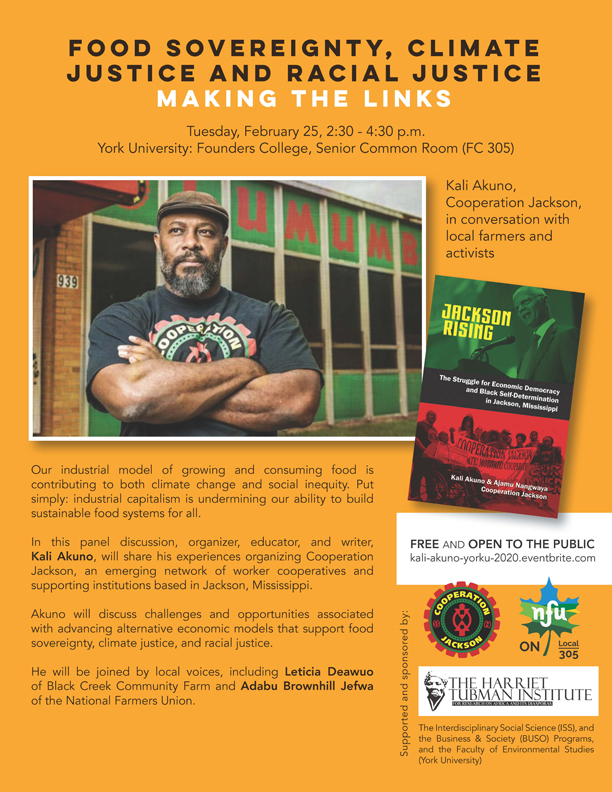
Where: Founders College, Room 305, York University, Toronto
Our industrial model of growing and consuming food is contributing to both climate change and social inequity. Put simply: industrial capitalism is undermining our ability to build sustainable food systems for all.
In this panel discussion, organizer, educator, and writer, Kali Akuno, will share his experiences leading Cooperation Jackson, an emerging network of worker cooperatives and supporting institutions. Akuno and Cooperation Jackson are fighting to create economic democracy by creating a vibrant solidarity economy in Jackson, MS that will help transform Mississippi and the South. We will then hear from local voices, including Leticia Deawuo of Black Creek Community Farm and Adabu Brownhill Jefwa with the National Farmers Union.
Many rightfully argue that alternative economies—including alternative food networks—continue to benefit middle class white folks, while further marginalizing communities of colour and low-income folks. In this panel, we ask: What alternative economic models can we point to, and to what extent can these models help achieve food, racial and climate justice together? To what extent can alternative economic models work for everyone, and how can they more meaningfully prioritize racially and economically marginalized folks?
A group of us have been busy developing a research project!
As a research collective, we are using anti-colonial feminist methodologies to do community-based research based on the vision and objectives expressed below. Our research collective currently includes Indigenous and settler academics, food provisioners, and community-based activists: Adrianne Lickers Xavier, Ayla Fenton, Danielle Boissoneau, Terran Giacomini, Lauren Kepkiewicz, and myself (Sarah Rotz), as well as RAIR research and program coordinators, Stephanie Morningstar and Sonia Hill.
The RAIR website is in development and coming soon!
Please note that this is a working vision document
Ourvision:
The purpose of this research project is to support
grassroots Indigenous rematriation[i]
and (re)connection to land. We seek to support the convergence of food
sovereign peoples in ways that advance dialogue and action for Indigenous land
rematriation. This work centres Indigenous women and two-spirit presence,
experiences and relationships to land and traditional territories. In turn, our
work is grounded in emergent feminist, decolonial, and activist methodologies.
The goals of our project are to:
Develop resources for Indigenous women, two spirit people, and their communities and relations to reconnect with and return to their traditional territories. To do so, the project has allocated its economic and social resources directly for Indigenous women and their communities. As well, Indigenous women and feminist modalities will remain at the centre of the decision-making process. The priority of the research collective is to use the resources that we have been given to serve this community.
Build relationships for food sovereignty that centre Indigenous land and food systems. This project will bring together both Indigenous and settler peoples in dialogue about land and rematriation in ways that are guided by our purpose to centre Indigenous relations to land. The goal of these dialogues is to advance understanding of and mobilize action around new ways of thinking about and relating to land. This includes not only legal ‘owners’ of land, but those who are on the land in various ways (e.g. renters, hunters, gatherers, and those involved in ceremonies and rituals etc.).
Decolonize relationships to one another and to land. This project is grounded in practices of relational accountability. We aim to remain accountable to one another and to share power. This work challenges hierarchies and affirms alternative ways of working together. Our work is based on a recognition that we each come from different places and experiences, and that our experiences are shaped by unjust power divisions. We continue to ask: how do we work together in a good way, in relation to each other and to the land? In this sense, we see our process itself as a method of research. We strive to build intentional and accountable relationships with each other and those within the broader movement for food sovereignty.
Objectives:
We will engage in outreach, writing and knowledge creation
practices that extend beyond academic forums and that benefit the communities
to which we are accountable. We prioritize community-based knowledge
dissemination and aim to publish popular resources as well as audio and visual
mediums, including podcasts and/or videos.
We strive to come together and share space as much as possible. We
aim to prioritize in-person meetings rather than phone and webinar
communication.
Popular education models. We strive to work collectively and build
community with each other. We will explore the methodology of ‘encounters’ as a
way of building authentic relationships based on shared struggle. The
methodology of the encounter prioritizes participants own experiences and
worldviews, and allows them to shape the agenda (i.e. deciding what to
prioritize and discuss, and what research looks like). It also encourages
learning and solidarity through collective work, skill-sharing, art-builds and
opportunities to share knowledge. Through the encounter process, we will mobilize knowledge and share what we’ve been doing. We are
also interested in working with other groups who have been doing encounters in
different parts of the world.
We prioritize hiring Indigenous community-based research
assistants and coordinators who have connections with the communities we serve.
We aim to work collectively to explore protocol(s) before forming
the Indigenous Advisory Committee. The Committee will be made up of Indigenous folks
who are connected to the communities we serve. We
will provide honoraria for their work, guidance and support. Together, we will
take direction from the committee to explore the language, ways, means, places
and timelines through which to conduct the encounter process.
[i] The term rematriation has been described as actions “to restore a living culture to its rightful place on Mother Earth,” or conditions where lands, waters and our relationships to them are intentionally returned to their natural or spiritual context (Newcomb, 1995). Bernedette Muthien has described rematriation as “reclaiming of ancestral remains, spirituality, culture, knowledge and resources, instead of the more patriarchally associated repatriation. It simply means back to Mother Earth, a return to our origins, to life and co-creation, rather than patriarchal destruction and colonisation, a reclamation of germination.” If, as Fanon describes, colonization has violently structured how we come to know and relate to the world. We understand the concept of rematriation as an act of restructuring how we relate to the land, one another, and ourselves. It encompasses the collection of thoughts, feelings and behaviours (both internal and interpersonal) that intentionally allow us to (re)connect, (re)interpret and (re)learn in ways that prioritize and restore an embodied and spiritual relationship to land.


 Sarah Rotz